

Procedures · Body
Thigh lift
The procedure is recommended if the inner thighs are sagging so much that it is no longer possible to tighten the skin in this area using BT. The effect of BT is limited, and if there is more excess skin, it can be removed surgically. For an inner thigh lift, the scars are located around the groin.
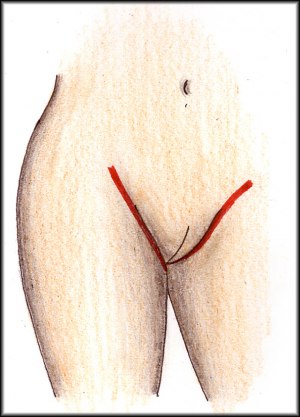
Some women have excessive fat deposits on certain parts of their bodies. The fatty tissue layer is conspicuously thicker here, increased local accumulation of the fatty tissue is usually caused by metabolic and hormonal reasons and very often, an inherited nature may be pinpointed. Typically, the most affected areas are those of the hips, the exterior sides of thighs above the hip joints, the buttocks, the inner thighs and knees and also the inner upper arms. The elastic fibres found under the surface layers of the skin break under the pressure of expanding fatty tissue, giving rise to tears in the skin’s fibrous layer know as stretch marks.
In some areas, the affected skin loosens even more, thus giving rise to sagging in the area of the thighs under the buttocks and the inner arms. This aesthetic defect may be resolved by surgery. If a woman arrives for surgery and her skin is still sufficiently elastic, liposuction treatment alone may prove to be a satisfactory solution. In the post-operation period, the sufficiently elastic skin is able to shrink and adapt to the new volume. If the incision is carefully made, the skin will typically reattach to the base without any visible unevenness.
If, however, the skin lacks in elasticity and hangs, a condition often accelerated by the pressure of expanding fatty tissue, liposuction treatment is not recommended. The skin is no longer able to promptly respond to the artificial reduction of the fatty tissue under it, and reattachment may cause the development of visible uneven areas, pockmarks and folds.
In cases like these, it is recommended to remove not only the excessive fatty tissue but also the corresponding excessive skin. After surgery, more extensive scars persist, but this is the only technique that results in shaping the figure up to a desirable form. The scars will fade out with time and be less striking. The final appearance of them is strictly individual.
Even patients after a significant weight loss may face problems with looseness of the skin. Also, with age, subcutaneous fatty tissue decreases and the skin’s elasticity is reduced. The skin in critical areas forms folds and pockets that make personal hygiene and clothing selection very difficult for the affected woman. However, even such a problem may be resolved by surgery, in which the excessive skin is removed, again, at the cost of scars.
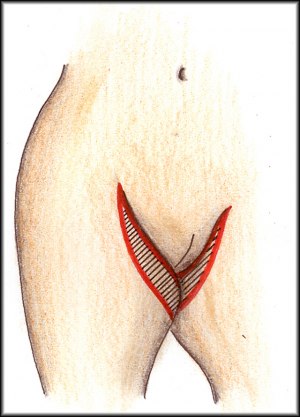
Where the local conditions permit, the surgeon will always make every effort for the resulting scars to be as small as possible.
Surgery and Post-Operation Period
Prior to the operation, the surgeon will carefully assess and plan the outline of the excessive skin to be removed. The operation is done under general anaesthesia and thus an important precondition is a good general condition of health in proportion to the scope of the surgery. By incisions taken according to the pre-operation assessment and sketch, the excessive skin is removed, as are the excessive fatty tissues, where necessary.
During the surgery of saggy inner thighs and under the buttocks, the incisions are taken so that the scar fall into natural folds in the groin and continues further to the fold under the buttocks. Removing the saggy area from the inner arms, the scar is situated along the inner part; sometimes it is bow-shaped on the boundary of armpit hair.
After the excessive tissues are sufficiently removed the surrounding skin is loosened so that the edges of the wound may be attached and the wound is sutured in layers. In some cases, where the subcutaneous fat layer is more marked, liposuction is included in the operation. If the operation is extensive or if the bleeding is stronger, drains are introduced to conduct blood and secretions from the wound during the first 24-hour period after the surgery. With a large accumulation of liquids in the wound under the loosened skin, the healing process would be considerably extended, and could be complicated by an inflammation or a bursting of the wound. These symptoms, together with raised temperatures, are the signs of a normal post-operation course.
The surgery is concluded with the application of compressive elastic dressings. The compression is inevitable for the uniform reattachment of the loosened skin to the base. The patient will remain at hospital for 1 day, subject to the scope of the surgery and to the post-op course, and then she is discharged into home care. On the 4th day after the operation take a shower, wear the elastic special garment all the time for 6 to 8 weeks. At the 7th to 10th day after the operation, the patient comes for examination, stitches are dissolvable.
Scars should be covered with special stripes for 3 to 4 weeks, change them every week, the scars will be thin. For the first time, the stripes will be replaced during the first examination. At the same time, her surgeon informs you about scar pressure massages.
Once the scars have healed perfectly, which is about one month after the surgery, you should massage the scars. Perform so-called pressure massages, that is, place your finger on the scar, push for five to ten seconds and repeat, massaging the entire scar. The scars will gradually soften and become light. Massages significantly speed up the healing process. Other examinations are made individually. Until the 14th-20th day after surgery the stitches are removed, if stitches are non dissolvable, a regimen of rest and walking (movement) is recommended. The movement of the arms should be restricted to unavoidable needs. If this regimen of rest is not observed as recommended, the swelling may be more pronounced, temperatures and pains may rise. With stronger pain, marked swelling and a temperature above 38°, the patient should seek the assistance of her surgeon immediately.
Elastic compressions in the form of a dressing or of a roll-on shall be left in place as long as the healing requires, depending on the plastic surgeon’s judgement, typically 3-6 weeks on the arms and 4-8 weeks on lower limbs.
The data presented is based on a common post-operation course. However, a recovery is an individual process depending not only on healing abilities of any individual body, but also on every patient´s conscientiousness. The patient is expected to set such conditions for a period of several days after his operation to be able, in case of any subjective problems or complication, to come as soon as possible for examination to our department. A positive operation result and mutual satisfaction is in your interest as well as in ours. Mutual trust and co-operation of the patient with the surgeon is a vital precondition.
Price
- Inner thigh lift from 1 900 € GA
Anaesthesia for this procedure
- GA
- general anaesthesia — You are asleep for the whole procedure.