

Procedures · Breasts
Breast reduction
Breast enlargement is done using implants or your own fat. If the breasts are small, breast enlargement can be done using implants, breast augmentation. The incisions are placed in the area under the breast fold. Implants are placed under the muscle if the breasts are small and firm, so that muscle tissue can also be used to cover them.
Operation
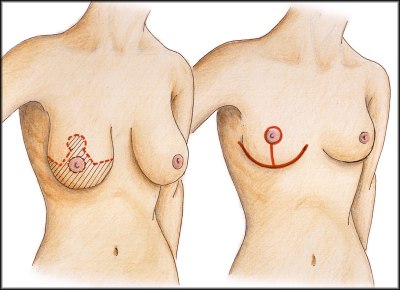
By breast reduction surgery an excessive breast tissue is removed. Breast modification can be also a part of the surgery if needed. The surgery is performed under general anaesthesia and takes 2-3 hours. It is necessary to wear surgical bra for 6 to 8weeks, hospitalization takes 1 day. The patient can return to work after a week and sport activities can be started after about 6 weeks. Unnaturally large breasts represent a significant health risk; their considerable weight overloads the spine and back. The patient complains about significant pain in the area of neck, back, shoulders and upper limbs. The breasts itself are rather sensitive and even painful. The weight of mammary gland deforms the shape of breasts and therefore the breast reduction surgery (removal of the mammary gland and breast-lift) brings not only a physical relieve but also mental well-being.
Ideal size: - ml, Mild hypertrophy (tissue proliferation): - ml
Moderate hypertrophy: - ml Marked hypertrophy: - ml
Macromastia: - ml Gigantomastia: over ml
These values are classification criteria for reference only. If a woman has subjective problems related to the excessive volume of breasts, the surgery is indicated. The causes include hormonal misbalance which appears in adolescence or at childbirth or lactation but also a considerable increase of weight and metabolic problems related to the thyroid disorder. The research confirms that some hormones influence the hypertrophy of galactophore (oestrogen, growth hormone, FSH) and other hormones causes the hypertrophy of the gland (prolactin, oestrogen, progesterone). Macromastia may be bilateral or unilateral. The latter is the result of primary growth stagnancy in one of the mammary glands.
What is a breast reduction surgery? Breast reduction is an operation which removes the excessive volume of mammary tissue, this operation includes breast-lift.
Are you a suitable candidate for breast reduction? You have to be healthy and with a good balance of mind and with realistic expectations concerning the operation and the final size of your breasts. Breast reduction is requested by women of all ages. Girls up to 20 years of age are not recommended for the therapy as their breasts are still expected to grow and the re-operation might be necessary. Girls suffering from a higher sensitivity to normal oestrogen level from their young age have a significant breast volume already at the age of 20 and are operated as early. In these women a re-operation is envisaged in the future.
Before the breast reduction surgery
If your breasts are too large to correspond with your body proportions and their weight causes health problems as dorsal pain or headaches, we can recommend you to undergo this operation. During the first consultation, the doctor shall talk to you about your expectations and reasons for breast reduction. First of all, he should understand your idea about the final size of your breasts. The doctor will consider the condition and elasticity of your skin and check your general health state to prevent possible complications during the operation and hereafter. The pre-operation examination considers the height and weight of the woman, chest shape and breast position (ptosis, height of inframammary fold and intermammary cleft). If you have reached certain age, you shall probably undergo a mammogram (breasts x-ray). Sometimes another two mammograms are made during the healing process. The surgeon co-operates with your gynaecologist and also sends you for comprehensive pre-operation internal examination. You should organize your transport home after the operation and assistance for one or two days, if you need it.
Pre-operation Plan
In the sitting woman with upper limbs along her body the surgeon marks the position where to move the nipples and areolas. This position is the intersection of the inframammary fold and a line directed through the centre of clavicle. The position is approximately in the middle of the arm; perhaps slightly higher in younger women. The areola is approximately 10-12 cm from the centre of the chest and approximately 20-22 cm from the suprasternal notch. The average areola is 40 x 40 mm in size.
The most suitable time for operation is the 1st week after menstruation when there is relatively less blood in the breast and the tissues are less influenced by hormones and do not retain water. Patients who take hormonal contraceptives are recommended to discontinue the pill and plan the procedure after a pause of at least 1-3 months. If the patient breastfed, she is recommended a pause of at least half or one year since the last breastfeeding.
The operation lasts for 2 hours. The treatment consists in removing the excessive volume of the mammary tissue. The classical incision is done near the areola, then vertically to the sulcus under the breast and continues in this line. The excessive tissue is removed and the breast is stretched. The most important step, which differentiates the particular techniques, is the transfer of the nipple and areola to the correct position. It uses the suspensions of the complex.
Vertical double-pedicle technique: The surgeon performs incision from the place marked for the areola to make a strip which includes the areola. The strip ends in the inframammary fold and the surgeon separates it from the deep structures of the gland. Then the lateral tissue of the breast is reduced and the areola transferred by frilling the upper part of the pedicle. This technique maintains the nerve and vascular supply of the areola and nipple from the upper and lower vascular and nerve branches. This technique is not suitable for large reductions.
Upper pedicle technique: Two parallel incisions are performed from the place marked for the future nipple-areola complex. The areola is separated from the lower part of the breast by a circular incision. In this stage the areola is attached only by the upper pedicle which is separated from the body of the gland. The breast is further incised downwards to the inframammary fold and in this fold. The surgeon removes sufficient amount of the gland and sutures the lower part of the breast. Then the upper pedicle is frilled and the areola area is gently sutured. The final scar is anchor-shaped.
Lower pyramid pedicle technique: The pedicle is attached by a large base in the inframammary fold and narrows upwards to the nipple. The pedicle forms a pyramid. The large base ensures very good blood circulation and nerve supply. This technique is suitable for young women as it does not restrict breastfeeding function. The surgeon removes excess tissue and skin above the pedicle.
Exceptionally, the nipple-areola complex is transferred as a free graft however there is a danger of graft rejection and interruption of nerve and vascular supply. The treatment includes adjusting the areola, which is usually moved and made smaller as well. That is why your breast shall look younger. At the end of the operation, your breasts will be covered with a sterile gauze.
Large part of breasts modelling can be performed with a new method “single scar”. It is a surgical procedure that respects anatomy of the body. The mammary gland is basically not damaged – the procedure is performed on its surface and partially below it, so it is possible to breast feed without problems after the surgery. Another advantage of this technique is very low risk of areola’s sensitivity reduction after the surgery. Although the main advantage still remains less amounts of scars that stays after the surgery, nevertheless it is necessary to count with a scar around areola and downward along the breast. If we choose this surgical procedure, we can save 2x15 cm of scars in the inframammary fold.
After the breast operation
You will probably feel a little pain during first hours after the operation; this pain can be effectively reduced by medication. Your breasts will be covered with sterile gauze and it is necessary to rest during the first days after the operation. On the next day following the operation, the drains are removed and upon applying a new dressing and elastic special bra, provided the operation wound and complete condition are good, the patient can be released to home treatment. Your breasts will be swollen and with bruises during the first days, the bruises start to disappear quickly. Some swelling can last even few weeks.
During the initial days after the operation, it is necessary to keep a rest regime without any physical load. On the 4th day after the operation take a shower, wear the elastic special bra all the time for 6 to 8 weeks. At the 7th to 10th day after the operation, the patient comes for examination, stitches are dissolvable. Scars should be covered with special stripes for 3 to 4 weeks, change them every week, the scars will be thin. You don't have to take off the strips to shower. For the first time, the stripes will be replaced during the first examination. At the same time, her surgeon informs you about scar pressure massages. Once the scars have healed perfectly, which is about one month after the surgery, you should massage the scars. Perform so-called pressure massages, that is, place your finger on the scar, push for five to ten seconds and repeat, massaging the entire scar. The scars will gradually soften and become light. Massages significantly speed up the healing process. Other examinations are made individually.
You can go back to work after one week, but if your job includes heavy physical activity, it is recommended to start working few days later. You should not practice sports and other physical activities for 6 to 8 weeks. Your nipples will be more sensitive for some time after the operation. Do not touch them as long as the contact is not pleasant. Do not forget that the scars never vanish completely. The doctor can recommend medical aids to quicken their disappearing. The final size of scars depends on the ability of your body to heal them. For 2 months there can be skin folds in the lower parts of your breasts, which later disappear.
Complications
The complications may be divided into non-specific which can occur after any operation. These are mainly bleeding and inflammatory complications, also blood clots are dangerous in the post-operative stage. This complication may be prevented by an early mobilization (it is suitable to start walking slowly after the operation). The specific complications typical for the concrete surgery include the danger of nipple and areola necrosis, or the change in pigmentation. We are often afraid of post-operative asymmetry. The patients are most often disturbed by the change in skin sensitivity. It is a natural condition after the operation and it should adjust within 3 months. In this time period the scars should become softer. In people with inclination to keloid scars (rigid punched out scars) every cosmetic surgery is contraindicated. As the tissue is scarred after the operation, the diagnostics of breast tumour is more difficult in the future. The lactiferous duct may be disturbed by the surgery and breastfeeding may be rather complicated. Cysts (globular formations filled with fluid or air) often forms in the operated area.
How long shall the result of the breast reduction surgery last? This operation has lasting results. It is however not possible to prevent the influence of time and gravitation and the breasts can drop slightly. To reach the best results, it is necessary to follow all recommendations of your doctor.
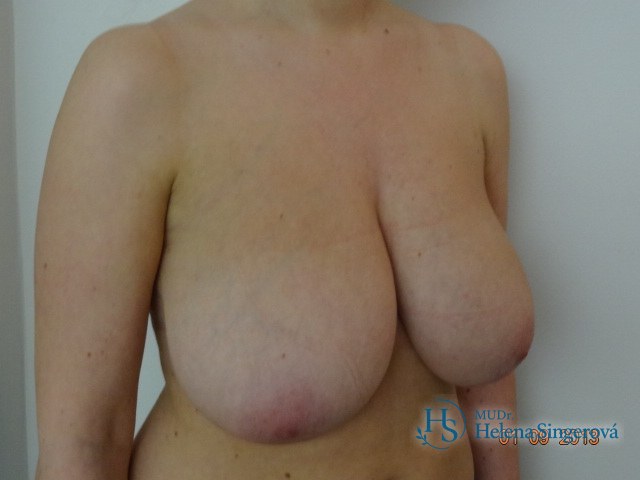
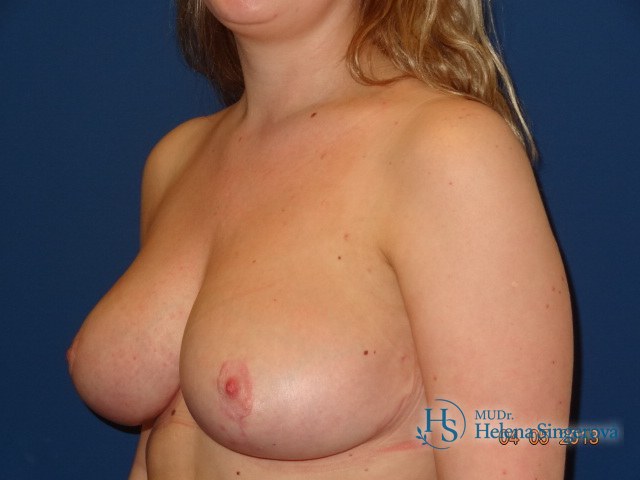
Price
- Breast reduction from 3 300 € GA
Anaesthesia for this procedure
- GA
- general anaesthesia — You are asleep for the whole procedure.